Who We Are
Mission Statement
Yonge Street Mission is called to demonstrate God’s love, peace and justice to people living in economic, social and spiritual poverty in Toronto.
As a not-for-profit Christian faith community, we acknowledge that every person is created in the image of God and has inherent value and dignity.
We assist as many people as possible to experience full participation in society.
We do this by:
1. Responding to basic human needs.
2. Inspiring people to achieve their full potential.
3. Offering services, programs and networks of mutual support, which enable those in need to improve their lives.
4. Providing opportunities for people to hear and respond to the Christian message of God’s love and forgiveness through Jesus Christ.
5. Assisting individuals and families to break the cycle of poverty in their lives.
6. Being a catalyst for healthy change within the community we serve.
7. Encouraging those we serve to participate in, and contribute to, the life of their community.
8. Cultivating a godly, committed and qualified team of staff and volunteers.
9. Developing strategic partnerships with churches, individuals, agencies, governments and businesses.
Since 1896, Yonge Street Mission has been reaching out to meet the needs of people living in poverty in Toronto. Our diverse programs have made a positive difference in the lives of families, seniors, socially isolated adults, street-involved youth and children growing up in our low-income community. Last year alone, we welcomed 18,000 individuals in over 185,000 visits.
At YSM, we’re committed to being a pivotal agent of change in the community. Our branches offer services, programs and networks of mutual support that allow those in need to improve their lives. These include food bank and meal programs, employment and computer training, school readiness programs, counselling, daycare and a post-secondary Education Award. With a staff of 130 and some 3,500 volunteers, we assist everyone who comes through our doors strictly on the basis of need.
We’re dedicated to inspiring all people to achieve their full potential, regardless of ethnicity, religion, economic status, gender, social condition or sexual orientation.
Some of our realities:
- Regent Park, one of the communities we serve, has the highest poverty rate in Toronto.
- 45% of local families have an annual income of under $20,000 per year.
- Our community has a high number of minorities and new immigrants. Child poverty rates for these groups can be as high as 90%.
- Up to 10,000 youth live on or very near Toronto’s streets. Approximately 70% of them have experienced some form of sexual, physical or emotional abuse.
- The average schooling completed by street-involved youth is grade 9.
- Food bank use has increased 81% since 1995. One-third of our food bank recipients are children.
Yonge Street Mission History
From its humble beginnings in 1896 with a horse-drawn “Gospel Wagon,” YSM has faithfully served the people of Toronto with compassion and dignity, helping those in need to turn their lives around. We’ve grown with our city, and adapted to its changing needs. Today we offer 100 programs and services. We reach out to street-involved youth, lonely seniors, families of recent immigrants who face a bewildering new culture, and others seeking help to achieve their full potential.
Changing With the Times: 1896-1948
Providing adequate, affordable housing has been a vital concern since the late 1800s, when “Cabbagetown” shanty houses sprang up. By the Great Depression of the 1930s, many working families doubled up in small houses, enduring wretched conditions. World War II exacerbated this trend as Toronto became a centre for war industry.
The Regent Park public housing project of 1948 was an answer to this crisis. Intended to replace old Cabbagetown, it offered modern plumbing and appliances in walk-up apartments and row houses. Much of YSM’s work has been focused in this area, which has Toronto’s highest poverty rate.
To address the growing need for affordable housing, YSM built Genesis Place in 1991. This 26-unit, non-profit, supportive housing facility offers rents geared to income. We also assist tenants in developing social, communication and relational skills.
The current Regent Park revitalization project is a hopeful harbinger of change in our immediate neighbourhood as our community undergoes another massive transformation. Yonge Street Mission will be here to help the Cabbagetown/Regent Park community adapt for a brighter future!
Yonge Street Mission Timeline
With reports from people who were there
|
1849 |
June 29 |
|
|
1896 |
The Mission Begins |
|
|
1900 |
Winter |
|
|
1897-1904 |
The Mission is relocated to rented premises at Yonge and Shuter Streets. |
|
|
1904 |
The move to 381 Yonge Street |
|
|
1914 |
Yonge Street Mission is incorporated. YSM’s 1914 Annual Report states: |
|
|
1921 |
YSM is protected from harm, even though the buildings next to it are badly damaged by fire. The shrieks of terror-stricken women aroused the neighbourhood at Yonge and Gerrard Streets in the early-morning hours of January 28, 1921. The great Forum Building was a raging inferno of fire, and the shrieks were of people who had barely managed to escape. Beside the Forum was the much smaller Yonge Street Mission, with only a brick wall as a fireguard between the two buildings. There was not so much as a blister of paint or stain of smoke on this building. For seven hours, Toronto’s firefighters battled the blaze as the chilly night air was heated by its flames. The Mission, instead of going about a rescue operation for itself, was open for business with coffee and sandwiches for the men who worked so hard. To a man, they wanted to save the Mission. |
|
|
1929 |
The Great Depression hits. YSM feeds and clothes thousands of people, going through 5,600 beef sandwiches, 80 gallons of tea and 26 gallons of milk a day. |
|
|
1930s |
From the Depression |
|
|
1950s |
From the Post-War Era |
|
|
1961 |
An office building on Victoria Street, right behind the Mission, is purchased to serve as the first Youth Centre, linked to the main building by a tunnel. It remains in use until 1966, when it is expropriated by Ryerson Polytechnic Institute (now Ryerson University). |
|
|
1962 |
Yonge Street Mission Youth Centre opens. |
|
|
1966 |
YSM Youth Centre is expropriated by Ryerson Polytechnic Institute. Land is purchased at Gerrard and Berkeley Streets for the site of the new Youth Centre. |
|
|
1968 |
Christian Youth Centre opens at Parliament and Berkeley Streets. |
|
|
1970 |
With the direction of an architectural firm, 381 Yonge Street undergoes extensive renovations. A coffee house is opened to attract the increasing numbers of young people visiting the Mission. |
|
|
1970s |
With the increasing numbers of welfare recipients, the Mission finds itself clothing, feeding and counselling hundreds of people every year. Men and women, young people and children whose lives are in need are still the main groups which comprise the Mission’s ministry. |
|
|
1979 |
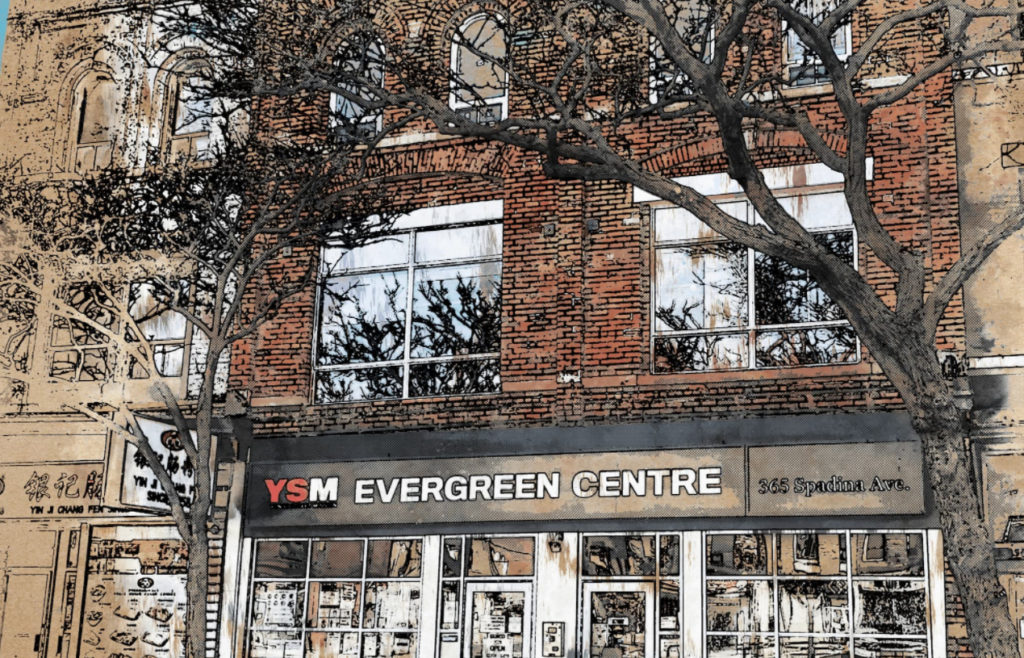
381 Yonge Street is renamed Evergreen. |
|
|
1985 |
Evergreen begins to focus on the needs of street-involved youth. Programs are tailored to this group of young people. |
|
|
1988 |
Hallelujah’s Muffin & Coffee Emporium opens, providing employment and job skills training for street-involved youth. |
|
|
1989 |
Renovated drop-in, nonprofit cafeteria is reopened in Evergreen’s basement. Rick Tobias is appointed Executive Director. |
|
|
1990 |
YSM begins its housing ministry, in cooperation with the City of Toronto’s Singles Housing Opportunities Program (SHOP). Two homes are opened, each accommodating five adults. |
|
|
1991 |
Official opening of Genesis Place, a 26-unit, non-profit supportive housing facility located adjacent to the Community Centre on Gerrard Street East. |
|
|
1992 |
Counselling branch opens in the Christian Community Centre. |
|
|
1994 |
Official opening of Health Centre at Evergreen, offering medical care and referrals, dental care, eye examinations and glasses, health education and promotion and chiropractic services for street-involved youth. All services are free and confidential. Evergreen’s programs and services are designed to restore health, hope and wholeness to a population of young people which have been broken by severe loss. Many of the youth that we come into contact with have experienced physical, emotional or sexual abuse at home. Daily life for street-involved youth is a desperate struggle that hardens and eventually destroys them. Petty crime, begging and prostitution are their survival tools, and the use of drugs and alcohol helps deaden the agony of fear and rejection. |
|
|
1996 |
February October |
|
|
1998 |
Evergreen Employment Resource Centre opens, providing job search, peer mentoring, employment readiness and life skills workshops, along with access to computers, Internet, phones, fax and photocopier. |
|
|
1999 |
Official opening of the 310 Centre that houses the Double Take thrift store and the TD Securities Computer Literacy Centre. |
|
|
2003 |
Partnering with YSM, the Royal Bank opens a Cash & Save branch in the 310 Centre. |
|
|
2004 |
May September |